Renting a vehicle in Nepal is easy. Renting the right vehicle, at a price that doesn't change halfway through your trip, takes a little more care.
Most disputes between renters and rental companies here come down to the same thing: something was assumed rather than agreed. The customer assumed fuel was included. The company assumed the driver's meals weren't. Nobody wrote it down, and the disagreement surfaces at 9pm in Pokhara.
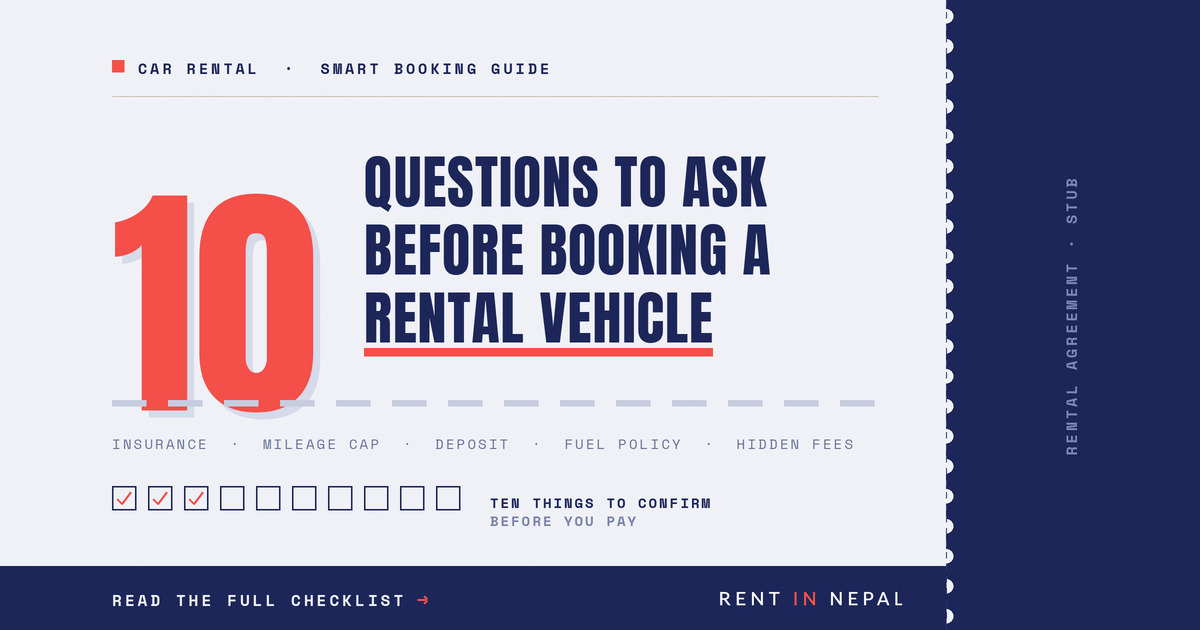
These ten questions take about five minutes to ask. Ask them before you pay a deposit, and almost everything that goes wrong with vehicle rentals in Nepal stops being possible.
1. What exactly is included in the quoted rate?
This is the question that prevents most problems, so ask it first and ask it plainly.
A rental rate in Nepal may or may not include:
-
Fuel — often excluded on long routes, included on short city hires
-
Driver's daily allowance — his food and lodging on overnight trips
-
Tolls and road taxes
-
Parking charges
-
Permits — required for Mustang, Manang, and several restricted areas
-
Overnight / halt charges — a per-night fee when the vehicle stays outside Kathmandu
None of these are hidden fees when they're stated upfront. They become hidden fees when they're not. Ask for the quote to list what's in and what's out, in writing.
2. Is this a per-day rate, a per-kilometre rate, or a package?
Nepal uses all three, and they suit different trips.
Per-day rates work well for sightseeing where you'll cover modest distances but need the vehicle available all day. Per-kilometre suits long point-to-point transfers. Package rates for popular routes — Kathmandu–Pokhara, Kathmandu–Chitwan are usually the simplest and safest for travellers, because the number can't move.
If you're quoted per-kilometre, ask how the distance is measured. From the garage or from your hotel? Does the return journey count if you're only travelling one way? A one-way drop often still carries a return charge, because the driver has to bring the vehicle back empty.
3. What happens if my plans change?
Trips in Nepal change. A flight gets cancelled, a road closes, a trek finishes a day early.
Ask:
-
Can I extend the rental mid-trip, and at what rate?
-
What's the cancellation policy, and how much notice do you need?
-
Is the deposit refundable?
-
If I add a destination, how is the extra charged?
A company that answers these clearly is one that has dealt with them before.
4. Which specific vehicle am I getting?
“An SUV” is not an answer. There is a real difference between a Scorpio and a Bolero, and a large one between either of those and a Hiace.
Ask for the model, the year, and the seating capacity. Then ask whether that exact vehicle is confirmed for your dates, or whether you'll get whatever is available on the day. Both arrangements are common; only one lets you plan.
If you're travelling with luggage, trekking gear, or camera equipment, say so now. Seating capacity and luggage capacity are not the same number, and a full seven-seater with seven bags is a problem you discover at the airport.
5. Can the vehicle handle the roads on my route?
This matters more in Nepal than almost anywhere else.
A sedan is fine for Kathmandu, Pokhara, and the Prithvi Highway. It is not fine for Mustang, Manang, or most trekking trailheads. Roads to Besisahar, Syabrubesi, and Jiri need ground clearance. Roads beyond Jomsom need a proper 4WD jeep and a driver who has done that route before.
Tell the company your full itinerary, including the rough side trips you're considering. A good operator will tell you when your chosen vehicle won't make it and one that just says yes to everything should worry you.
6. Is the driver experienced on this specific route?
In Nepal you are not really renting a vehicle. You are renting a vehicle and the person driving it, and the driver matters more.
Mountain roads here demand route-specific experience: knowing where the road narrows, where landslides recur, where to stop, how long the drive actually takes in the current season. A skilled Kathmandu city driver may never have driven to Muktinath.
Ask directly whether the assigned driver has done your route, and how recently.
7. Does the driver speak English and do I need him to?
If you're an international visitor spending eight hours a day in a vehicle, this shapes the whole trip.
Many drivers in Nepal speak functional English. Some speak it well enough to act as an informal guide, pointing out what you're passing and helping with restaurants and hotels. Others speak very little. All three can be fine, depending on your trip but decide which you need rather than finding out on day one.
If you specifically want a driver who can double as a guide, say so. It's often available and sometimes costs a little more.
8. What insurance covers this vehicle, and what covers me?
Ask what the vehicle's insurance actually covers and what your liability is if something happens.
For self-drive rentals this is essential. Find out the excess or deductible amount, what's excluded, and what the process is after an accident. Get it in writing.
For chauffeur-driven rentals, the large majority of bookings in Nepal, liability generally sits with the company and driver, but you should still confirm that the vehicle carries valid third-party and comprehensive insurance, and that the papers are current.
Separately: your own travel insurance should cover road travel in Nepal. Some policies exclude certain regions or activities. Check before you go.
9. What happens if the vehicle breaks down?
Mountain roads are hard on vehicles. Breakdowns happen even to well-maintained fleets. What separates a good rental company from a bad one is what happens next.
Ask:
-
Do you have a replacement vehicle available, and how long would it take to reach me?
-
Who pays for repairs and the lost time?
-
Is there someone I can reach 24 hours a day?
-
What's the backup plan in a remote area with no other vehicles nearby?
An operator with a real fleet and a real support line can answer this immediately. A broker with one borrowed vehicle cannot.
10. Can I see the booking terms in writing before I pay?
Everything above should end up in a written confirmation: dates, vehicle, route, total price, what's included, deposit amount, cancellation terms, and a contact number that works outside office hours.
This isn't about distrust. It's about the two of you having the same understanding of the same trip. Verbal agreements are held in good faith by everyone and remembered differently by everyone.
Any established rental company will provide this without hesitation. Reluctance to put terms in writing is the clearest warning sign in this industry.
A quick pre-booking checklist
Before you send the deposit, make sure you can answer:
-
What's included and what's extra
-
How the rate is calculated
-
Which vehicle, confirmed for my dates
-
Whether that vehicle suits my route
-
Whether the driver knows my route
-
Language expectations
-
Insurance position
-
Breakdown and support plan
-
Change and cancellation terms
-
All of it, in writing
Booking with confidence
The right questions turn vehicle rental from a gamble into a straightforward transaction. A company that welcomes them is telling you something useful about how they operate.
At Rent in Nepal, we quote with inclusions listed, confirm the specific vehicle before you pay, and match drivers to routes they know. If you're planning a trip and want a clear answer on cost and the right vehicle for where you're going, tell us your dates and itinerary and we'll put it in writing.
Get in touch: 015929580
Planning a specific route? Read our detailed guides to [Kathmandu to Pokhara], [Kathmandu to Chitwan], and [Muktinath by jeep].